# 华丽的数据结构之Bloom Filter
- URL: https://www.yidoo.xyz/bloom-filter
- 作者: 核动力蜗牛
- 发布时间: 2013-11-02
- 更新时间: 2013-11-02
- 分类: 华丽的数据结构
# Bloom Filter 简介
Bloom Filter(中文译作:布隆过滤器)是 1970 年由 Bloom 提出的。它实际上是由一个很长的二进制位数组和一系列 Hash 函数组成。
Bloom Filter 是一种空间效率很高的随机数据结构,它利用位数组很简洁地表示一个集合,并能判断一个元素是否属于这个集合。Bloom Filter 的这种高效是有一定代价的:在判断一个元素是否属于某个集合时,有可能会把不属于这个集合的元素误认为属于这个集合(false positive)。因此,Bloom Filter 不适合那些“零错误”的应用场合。而在能容忍低错误率的应用场合下,Bloom Filter 通过极少的错误换取了存储空间的极大节省。
# Bloom Filter 算法
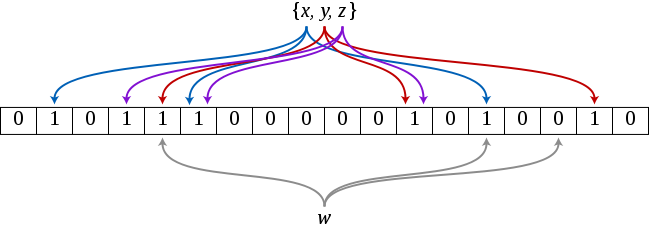
创建一个 m 位 BitSet,先将所有位初始化为 0,然后选择 k 个独立的哈希函数。第 i 个哈希函数对字符串 str 哈希的结果记为 hash,,i,,(str),且 i 的范围是 0 到 m-1 。有关 Bloom Filter 的操作的过程可以参考
## 添加字符串
对于字符串 str,分别计算 hash,,1,,(str),hash,,2,,(str)…… hash,,k,,(str)。然后将 BitSet 的第 hash,,1,,(str),hash,,2,,(str)…… hash,,k,,(str)位设为 1。就此,就完成了将字符串 str 映射到 BitSet 中的 k 个二进制位。
## 查找字符串
下面是检索字符串 str 是否在 BitSet 中:
对于字符串 str,分别计算 hash,,1,,(str),hash,,2,,(str)…… hash,,k,,(str)。然后检查 BitSet 的第 hash,,1,,(str),hash,,2,,(str)…… hash,,k,,(str)位是否全为 1。
若一个字符串对应的 bit 位不全为 1,则可以肯定该字符串一定没有被 Bloom Filter 记录过。
但是若一个字符串对应的 Bit 全为 1,实际上是不能 100%的肯定该字符串被 Bloom Filter 记录过的。因为有可能该字符串的所有位都刚好是被其他字符串所对应,这种将该字符串划分错的情况,称为 false positive 。
## 删除字符串
在基本的 Bloom Filter 中,字符串加入了就被不能删除了,因为删除会影响到其他字符串。实在需要删除字符串的可以使用Counting Bloom Filter(CBF),这是一种基本 Bloom Filter 的改进,CBF 将基本 Bloom Filter 每一个 Bit 改为一个计数器,这样就可以实现删除字符串的功能了。
# Bloom Filter 参数选择
## hash 函数选择
hash 函数的选择对性能影响比较大,一个优秀的 hash 函数应该做到将字符串等概率的映射到各个 bit。与此同时,选择 k 个不同的 hash 比较繁琐,一种简单的策略就是采用同一个 hash 函数然后传入 k 不同的参数。下面列举的是一些软件框架中 BloomFilter 所使用的 hash 函数。
- Cassandra 使用的*Murmur hashes*
- Hadoop 默认使用 _Jenkins and Murmur hashes_
- python-bloomfilter 使用*cryptographic hashes*
- Plan9 使用*Mitzenmacher 2005*
- Sdroege Bloom filter 使用*fnv*
- Squid 使用*MD5*
## Bloom Filter 参数\*
哈希函数个数 k、位数组大小 m、加入的字符串数量 n 的关系可以参考。该文献证明了对于给定的 m、n,当
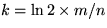
时出错的概率是最小的。
同时参考文献中也给出了 false positive 概率与 m、n 的关系。false postive 概率等于
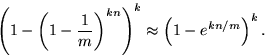
完整的参数关系推导请参考
# Bloom Filter vs HashMap
Bloom Filter 跟 HashMap 不同之处在于:Bloom Filter 使用了 k 个哈希函数,每个字符串跟 k 个 bit 对应,从而降低了冲突的概率。
# Bloom Filter 代码实现
GitHub: https://github.com/zhenlohuang/BloomFilter>
# 参考资料
布隆过滤器:
BloomFilter——大规模数据处理利器:
Bloom Filter 概念和原理: